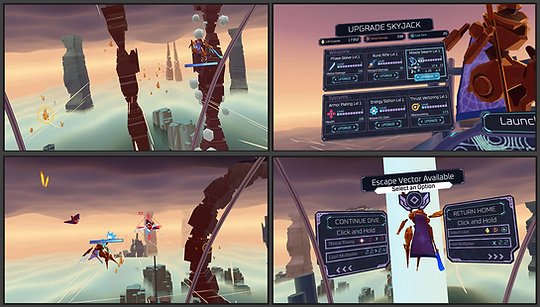
Switching Gears for
Vehicular Reality
Holoride & Schell Games
Lead UX Designer, Lead UI Developer
6 Months
Project Highlights
What I Did
UX Strategy and Ideation
UX and Product Design
UX / UI Development in Unity
Inclusivity Advocacy
Learnings
UX Design Space of VR in Vehicles
UX Strategies for VR in Motion
Inclusivity Considerations in VR
Mobile VR Optimization Techniques
Outcome
Demo Build Complete 2021
Oculus Quest and Pico Neo 3
Positive Stakeholder Response
Client Contract Renewal
Start Your Engines!
In 2021, the Holoride team returned to work with Schell Games on a new challenge. Previous contracts had focused on tailored virtual experiences built for chauffeured thrill-ride racetracks. Holoride was ready to take the next step in their larger business strategy: Consumer XR Products.
Holoride was in the final development phases for its XR hardware platform and a developer facing toolset called Elastic SDK. These products allowed Holoride technology to turn any car trip into a VR experience for passengers. Elastic SDK was in beta and they wanted to test it in hands of an independent developer to test drive a production cycle. Their goal was to have a complete interactive centerpiece, showcasing the possibilities of exploring VR worlds while driving through the real one.
The Challenge
VR as a technology has numerous weaknesses related to user comfort and trust. Holoride's technology gave access to GPS, Open maps data, and acceleration force readings to allow the simulation to reflect what was happening on the car. Our challenge was to translate that data into a simulation that was stable and comfortable for players.
This experience also needed to be compelling in a broad spectrum of use cases. Stuck in traffic? Speeding down a highway? Pulling into the Walmart parking lot? It would need to demonstrably adapt to many possibilities, dynamically changing with the world around it.

My Strategy
Designing the UX for something this broad needed to start with strong foundational understanding. Previous Holoride research was our first resource to start the race. UX discoveries and considerations from their internal design teams helped inform our own proposed solutions.
We needed to look at the problem from varied audience perspectives to ensure we were designing for general usability and not specific anecdotes. We would be building a set of rules of reactivity, taking common vehicle maneuvers and trip data to map out the game's responses.
Smooth Sailing
VR in any moving vehicle can be intense. Ensuring user comfort and usability is paramount to success.
A Thrill for Every Ride
We needed to cover many scenarios that arise during drives and have plans for common events.
Elastic SDK
We were selling Holodride with this demo. It must showcase their features and offerings to stakeholders.
Imagining VR in a Car
Early work centered on brainstorming how we could capture the inherent promise of playing VR in a maneuvering vehicle. Feature concepts and prototypes looked to integrate the AR data and show it in compelling ways that highlighted the novelty of the vehicle data suite. The magic was having the virtual world react to acceleration, stopping, and turns to amplify the presence and immersion.
But the magic of VR vanishes when you barf. We had to reduce stressors like unexpected maneuvers, eye tracking dizziness, and disorientation. These were proving to be common physiological responses for ourselves and our players.
Focus testing reported motion sickness and comfort as a primary issue. Any experience needed to solve for these discomforts to avoid reinforcing the aversion to the technology.


Constraining Sight Lines
Research showed the most dramatic discomfort situations occurred when users were not looking straight and forward.
My early proposals employed this learning and encourage users to look in the front arc. Diegetic UIs would be positioned for reference in a narrow FOV in front of the player and environmental blinders would naturally constrain the user to look out the 'front viewport'.
Using a 3rd person avatar as a focal point was also an elegant solution. Giving the player a character to focus their attention to the front viewing arc of the car would naturally encourage them to avoid the most uncomfortable element of VR in a car.
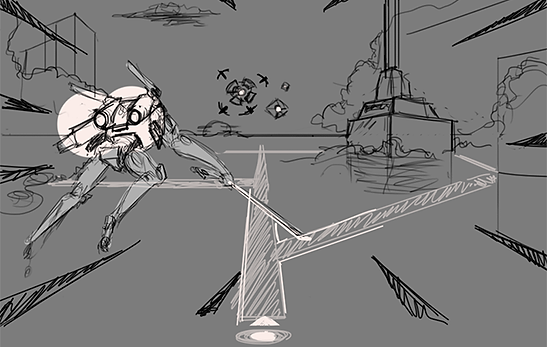

Showing the Map
Players felt disoriented when the real world was too obscured or abstracted by the virtual. They couldn't tell when turns were going to occur, what direction they were about to move, and what kind of acceleration forces they may feel.
Feature proposals to address this focused on showing map data as environmental structures, a mini-map, or even graphical world pathing. This helped users know where possible maneuvers could occur and brace themselves.
Using the Reticle
Users eyes are often locked on the aiming reticle as a key focal point in standard screen based games. In fact, reticles are often an excellent assistive feature to reduce user motion sickness!
I proposed having the reticle react to Vehicle Data to prime users about changes occurring. The reticle would twist to indicate a turn was starting, elongate or shorten to show acceleration changes, and act as a distant focal point to watch to help with near object disorientation.


Preproduction
We decided a 3rd Person 'infinite runner' style gameplay gave us the scaffolding to solve a number of game design issues. Indeterminate game length, Roguelite replay, and session play loops proved a good fit for Holoride's sales pitch. A huge UX win was also the advantage of a controllable Avatar that users can focus on, which showed improvements on playtester motion sickness.
The next phase involved ideating and building out a set of mechanics around our moment to moment gameplay and meta game progression. Focus was placed on planning core user interfaces, user flows, and gameplay feedback features that were functionally testable in our demo environment.
Whiteboarding, storyboards, wireframes, and rough prototypes were the primary output artifacts during this collaborative phase.


UX Production
The game's demo was meant to be a quick pickup-and-play experience. In fact, most of the game design was angled to be as simple as possible to ensure the game was never too distracting. This demo was meant to be played while Holoride representatives explained the technology and pitched to investment partners. If it took up all the attention it would defeat its own purpose!
Users described the experience as being far more intense than anticipated. VR in a car can be both exhilarating and overwhelming in its sensory effect. Strategies to reduce visual noise, choices, and cognitive load were vital.
Rule of 3
Keeping things simple once the ride started was paramount. Because it is not easy reading an instruction manual when you feel like you're on a roller coaster!
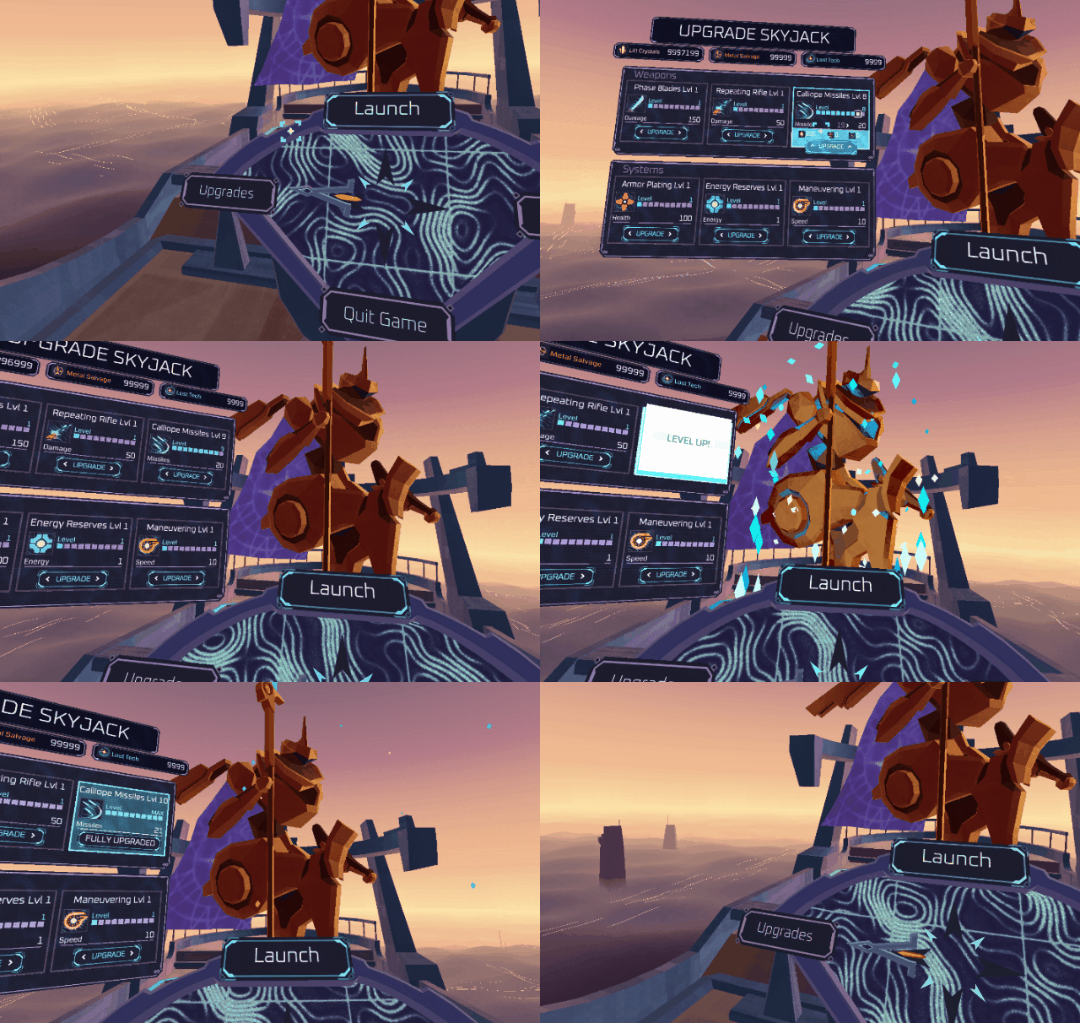
Onboarding for the game was designed to be simple with a glance read to get through the 3 primary instructions quickly. Kill drones, grab loot, push these 3 buttons to do cool things with your Skyjack.
Simplicity, was also the name of the game for the vehicle dashboard, which held 3 stats for players to have an easy read at a glance.
In fact, we leveraged the Rule of 3 across most of the design and presentation. Three things is considered a sweet spot for retention in memory and cognitive science, and this helped us scale back the game design to be comfortable to parse.


Thrill Rides Need Thrills
Early versions of the game lacked any kind of interest curve. Waves of enemies attacked you, you picked up loot, and rinsed and repeated until the vehicle was put in park.
To sell the aspiration of the title and the fantasy of it being a larger budget release in the context of the Holoride platform going wide, we needed excitement.
Moments like the Drone Swarm encounter added an emotional oomph to spike interest in the game. Emotional interest peaks helped break up the structureless sequences happening to the player and created a cadence of play. This polish helped make Cloud Breakers feel real.
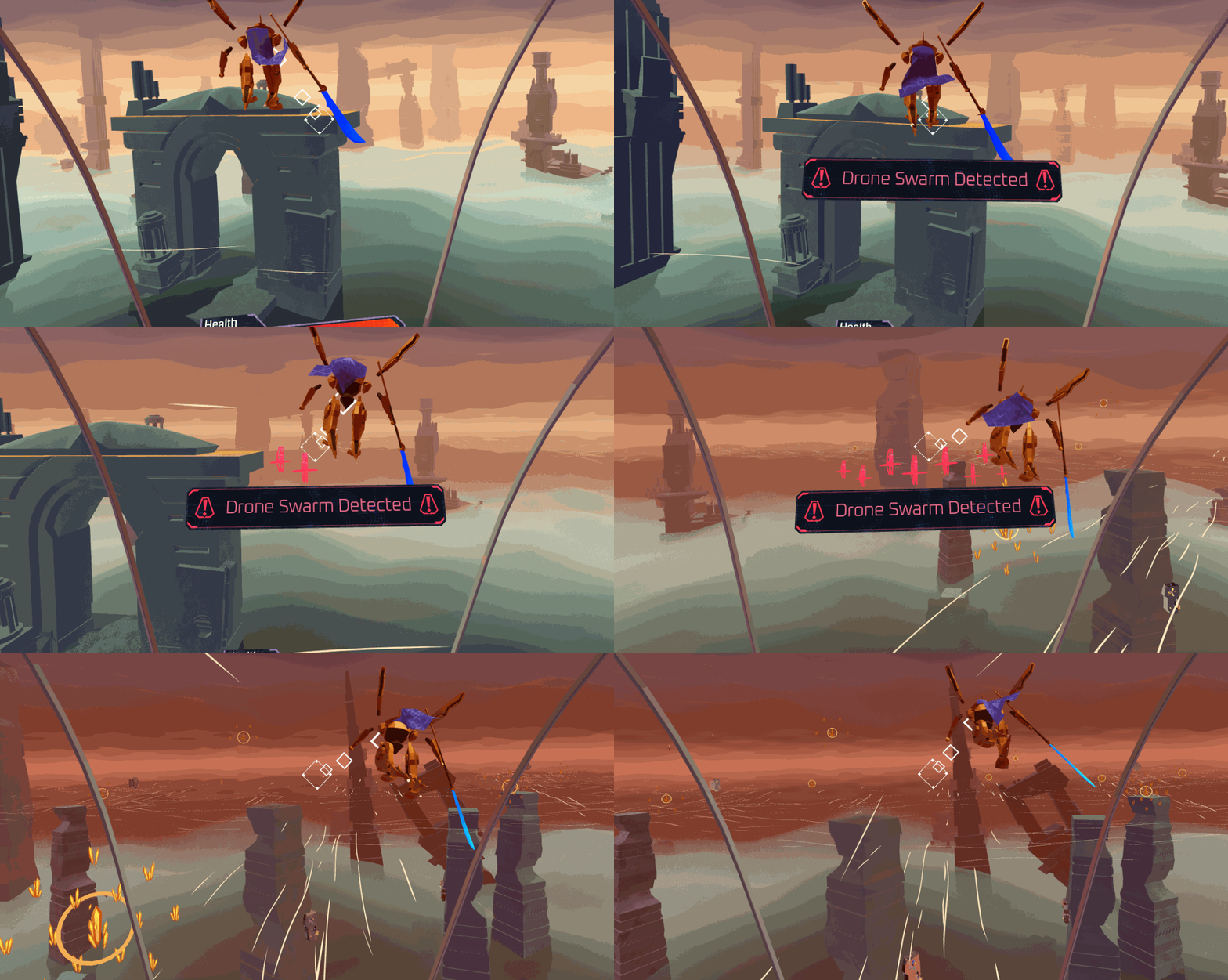
User accuracy with controllers was extremely low in a moving vehicle. Micromotions, vibrations, and changes in balance impaired the reliability of the VR motion controllers and were error prone.
The Jitters
A big challenge we faced during development was with the traditional VR motion controllers. Most VR titles allow the user to use the controllers as a pointer or as a digital hand to interact with user interfaces. Neither solution was usable in a moving car.
Cars hit bumps, turn suddenly, and regularly change acceleration. Using sensitive 6-DOF motion controllers while in that environment was hell. Not good for an exciter demo.
Our solution was to put the functionality on the headset in VR, turning the player's center eye into a laser pointer for selection. The reasoning was that most players' kept their head relatively stable, thanks to stronger neck muscles and our amazing vestibular system. This meant they could naturally dampen the outside forces on the VR headset. It was an instant success.
Final Product and Outcome
CloudBreaker was handed off to the Holoride team at the completion of our alpha development phase in 2021. Client stakeholders were excited with the project's progress and were keen to continue development with a future contract.
We had a stable build running on both Oculus Quest and Pico Neo 3 mobile VR hardware setups. The demo was well received in test drive experiences with players enjoying piloting battle robots while being driven around Los Angeles!
Testing showed huge improvements on self reported motion sickness during playtests. These were strong findings to tackle some the biggest UX hurdles for the technology. For me, it was a thrilling opportunity to help paving the way for comfortable VR experiences in vehicles!